2026 DRSN QuPath Workshop
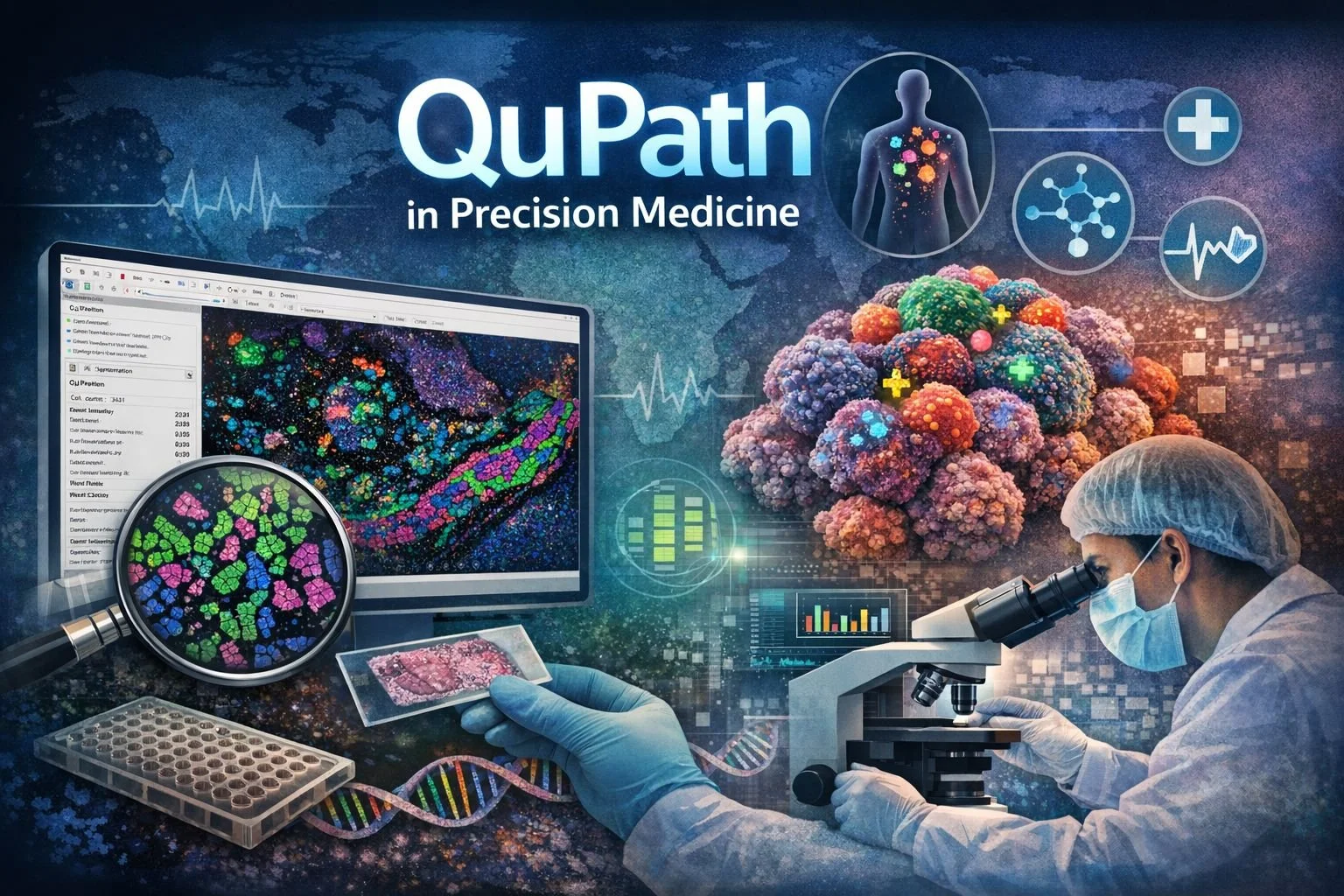
Digital image analysis is no longer a “nice to have” in precision medicine - it’s foundational. Our latest Digital Research Skills Network (DRSN) session at WIMR focused on QuPath, an open-source platform for bioimage analysis, led by Elizabeth Dunn from the University of Sydney and The Westmead Institute for Medical Research. In this workshop, we explored how QuPath can be used to analyse multiplex fluorescence whole slide images, including:
• Annotating tissue regions of interest
• Thresholding to identify infected vs uninfected areas
• Measuring staining intensity and area
• Cell segmentation using Instanseg
• Detecting RNAscope signals
• Exporting quantitative outputs for downstream analysis
These are not just technical skills - they're important translational skills. In precision medicine - and in initiatives like PrecisionGo® - our ability to generate high-dimensional spatial and molecular data is only as powerful as our ability to analyse, interpret and integrate it. Image analysis tools like QuPath enable researchers to move from beautiful pictures to reproducible, quantitative insights. That shift, from visual impression to measurable biology, is where clinical impact begins.
If you are working in spatial biology, pathology, imaging, multi-omics, or simply curious about how digital tools are reshaping translational research, this session is well worth your time. Visit our website for more: https://www.digitalresearchskills.network/
You can watch the recording here:
🔗 https://youtu.be/E-dtPfAFnEA?si=AMzcG0fUqNz71Axx